

The Research, Development and Innovation (R&D&I) Clause of Brazil’s National Agency of Petroleum, Natural Gas and Biofuels (ANP) is one of the country’s most significant regulatory instruments for fostering technological innovation in the Brazilian oil, natural gas and energy industry. Established under oil and gas exploration and production agreements, it requires companies subject to the concession and production-sharing regimes to invest 1% of the gross revenue generated by fields falling within the scope of the clause, while under transfer-of-rights agreements, the applicable percentage is 0.5%. These funds must be allocated to research, technological development and innovation projects in accordance with ANP regulations.
Over the years, the regulatory framework governing R&D&I investments has evolved significantly, culminating in ANP Resolution No. 918/2023, which consolidated and modernized the applicable rules, aligning them with trends in the energy transition and digital transformation. Eligible projects currently include those related to carbon capture, utilization and storage (CCUS), low-carbon hydrogen, renewable energy, artificial intelligence, automation, digitalization, information and communication technologies (ICT), as well as initiatives focused on energy efficiency, decarbonization and emissions reduction. In this context, the R&D&I Clause is no longer perceived solely as a regulatory obligation, but has assumed a strategic role in promoting competitiveness, innovation and Brazilian industrial development.
The funds may be used to finance basic research, applied research, experimental development, prototype development and validation, pilot units, laboratory infrastructure and the training of specialized human resources. The framework also encourages interaction among operators, universities, research centers, startups, technology companies and other participants in the innovation ecosystem, strengthening Brazil’s technological capabilities and fostering closer ties between scientific research and industrial applications.
In simplified terms, the structure of a project financed with funds under the R&D&I Clause may be represented as shown in Figure 1.
Figure 1 – Simplified Flow for Structuring R&D&I Projects
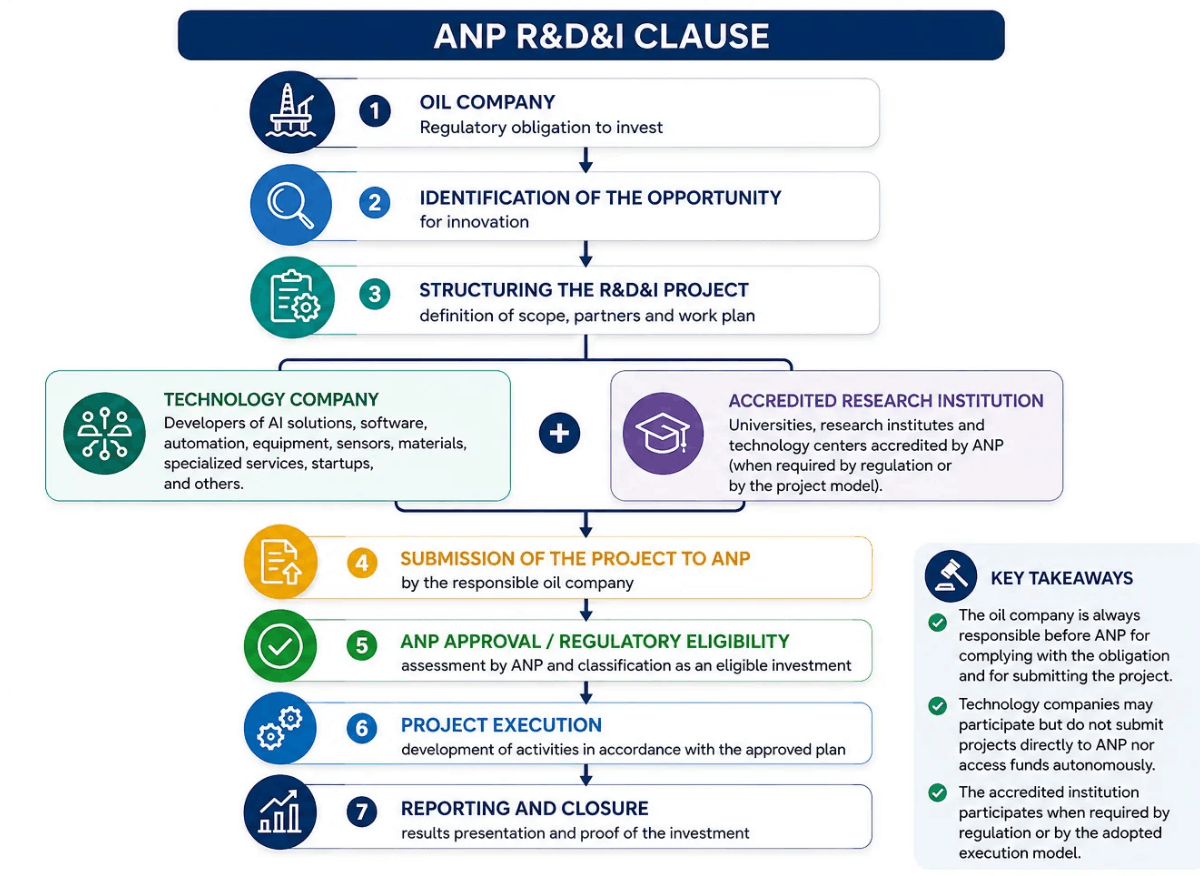
From a regulatory perspective, oil companies remain responsible for complying with the statutory investment obligation and for submitting projects to the ANP, in accordance with the technical requirements established under the applicable regulations.
Accredited research institutions continue to play a central role in project implementation, particularly universities, research institutes and technology centers accredited by the Agency. However, the regulatory framework also allows broad participation by Brazilian companies, including startups and technology-based companies, through co-execution agreements and other forms of partnership with operators or accredited institutions.
In practice, companies developing software, artificial intelligence solutions, automation, robotics, equipment, sensors, environmental technologies, advanced materials and specialized services may participate in projects financed with funds under the R&D&I Clause. However, these companies do not submit projects directly to the ANP, nor do they independently access such funds. Their participation necessarily takes place through an oil company subject to the investment obligation or, depending on the implementation model adopted, in partnership with an accredited research institution responsible for carrying out part of the project activities.
In this context, it is important to distinguish the circumstances in which ANP accreditation is actually required. ANP Resolution No. 917/2023 governs the accreditation of institutions authorized to perform certain research, development and innovation activities under the R&D&I framework. As a rule, however, Brazilian companies acting as technology developers or innovation service providers are not required to be accredited in order to participate in projects financed with funds under the R&D&I Clause. In such cases, their participation takes place through a partnership with the oil company responsible for the mandatory investment or, where applicable, with an accredited institution, while the oil company is responsible for submitting the project to the ANP for assessment of its eligibility as a qualifying investment.
Accordingly, the absence of accreditation does not prevent Brazilian companies from participating in innovation projects. Such companies may not, however, independently submit projects to the ANP or directly apply for recognition of the investments as eligible expenditures. The project must necessarily be structured jointly with an oil company responsible for complying with the regulatory obligation and, where required by the applicable regulations or by the implementation model adopted, with an accredited research institution. In all cases, the oil company remains responsible for selecting and engaging the relevant participants, submitting the project (where applicable), and providing the required reporting and accountability to the ANP.
The legal structuring of these projects requires particular attention to regulatory, contractual, tax and intellectual property matters. Properly defining each participant’s responsibilities, project governance, accountability and reporting criteria, as well as the rules governing ownership and exploitation of intellectual property assets, is essential to ensure compliance with ANP Resolution No. 918/2023, mitigate the risk of regulatory disallowances and issues arising from ANP audits, and provide legal certainty throughout all phases of the investment.
The regulatory framework also facilitates the participation of foreign companies through the establishment of subsidiaries in Brazil, joint ventures, co-execution agreements or strategic partnerships with Brazilian institutions, thereby expanding opportunities for foreign direct investment (inbound investment) and technology transfer. By encouraging cooperation among operators, Brazilian companies, research institutions and foreign investors, the R&D&I investment framework fosters an environment conducive to open innovation, the development of high-value-added solutions and the strengthening of Brazil’s domestic supply chain, further reinforcing Brazil’s position as a major hub for technological innovation in the oil, natural gas and energy sectors.
By Julia Borges da Mota and Thiago Bandeira
Source: TN Petróleo
Photo: Canva
Recent Comments