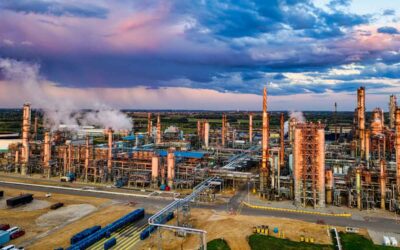
Petrobras has presented its 2026-2030 Business Plan, reaffirming its focus on oil and gas with economic and environmental resilience, reserve replacement, and industrial expansion to monetize national oil and increase the supply of low-carbon products.
The company emphasized that the Brazilian energy matrix will remain more renewable than the global matrix, while oil and gas will continue to play a relevant role in the country’s future. Petrobras aims to expand its share in energy supply: in 2022, it accounted for 31% of Brazil’s energy sales, and intends to increase this percentage by 2030 and 2050.
The external scenario, marked by lower oil prices, requires capital discipline and operational efficiency. Measures announced include: resilient cash flow with a Brent equilibrium of US$ 59/bbl in 2026, average annual reduction of 8.5% in operating expenses, convergence of gross debt to US$ 65 billion, and the creation of a financial sustainability group with additional governance for expenditure analysis.
Petrobras projects 12% production growth by 2028, with high-return projects: 23% in exploration and production, 15% in refining and transportation, and 10% in gas and low-carbon energy. The investment portfolio totals US$ 109 billion, including ongoing and evaluated projects.
Another highlight was the Open Sea Project, with investments of US$ 2 billion between 2026 and 2030 for the construction of 20 cabotage vessels and 18 barges, plus more than US$ 4 billion in chartering 40 support vessels. The project ensures logistics for operations and encourages the Brazilian naval industry, being considered a strategic vector for a just energy transition.
Regarding the energy transition, the first step will be a focus on bioproducts: biodiesel, biomethane, ethanol, R5 diesel, and biobunker. The US$ 13 billion allocated to the energy transition includes investments in decarbonization, profitable diversification, and R&D in low-carbon solutions. Petrobras also reinforced its goal of ensuring energy access, generating jobs, and guaranteeing dividends to both private and governmental shareholders, consolidating energy as a driver of Brazil’s economic and social development.
Photo: Canva